Healthcare access under uncertainty
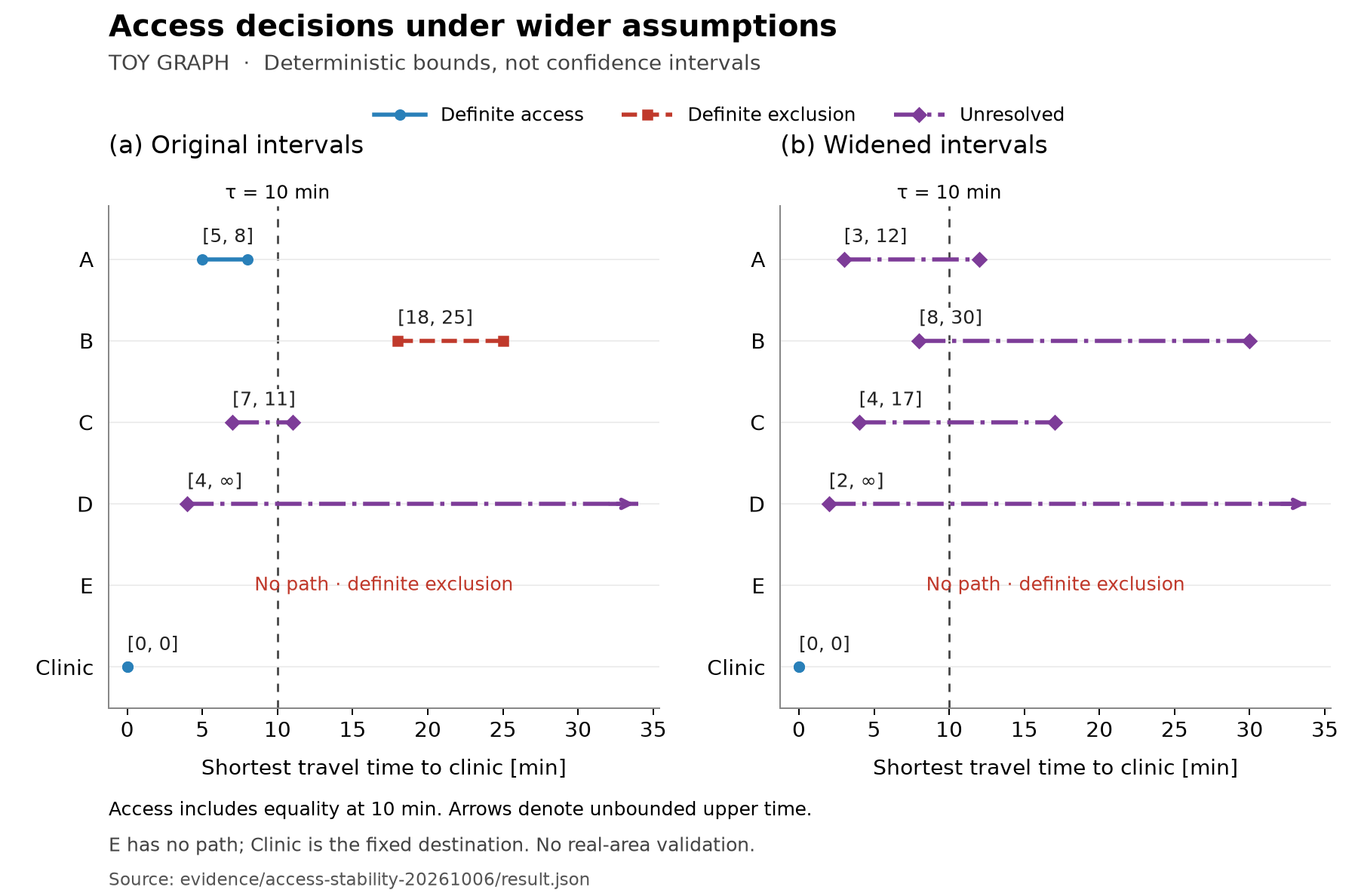
Shortest-path calculations that show how travel-time uncertainty affects access classifications.
Synthetic method demonstration
Verified classifications on a toy network and scaled the bound calculation to 32,577 nodes and 67,290 directed arcs from Sofala OSM topology. Original-plus-widened bound runs took a median 139.616 ms on the recorded host.
results and contributions
| Largest topology fixture | 32,577 nodes / 67,290 directed arcs |
|---|---|
| Median paired bound run | 139.616 ms on the recorded host |
| Time and closure inputs | Synthetic development assumptions |
figures and hardware
Open any image at full size. Source links identify the retained revision.
design evolution
The design and analysis steps that produced the current work.
| Work | Engineering question | Approach | Outcome |
|---|---|---|---|
| Corridor detection | Exercise corridor extraction on controlled synthetic scenes. | Built the Sentinel-2 detector and preserved its test inputs and outputs. | Implemented and retained the synthetic-scene detector pipeline. |
| Trip feasibility | Check whether timestamped trip records can be parsed consistently. | Qualified UCI traces as development inputs for the parser. | Parsed 19 usable UCI traces to exercise the ingestion pipeline. |
methods and scope
Sofala supplies network topology; edge times and closures are synthetic. Timings describe the recorded host and workload, and do not measure healthcare-access accuracy. Historical Idai inputs and reuse terms remain under source review. Missing roads and facility assumptions can invalidate bounds outside the modeled network.
project record
| Evidence | Synthetic method demonstration |
|---|---|
| Status | In Progress |
| Timeline | 2026 |
| Role | Shortest-path bounds, input qualification and reproducible toy examples |
| Tools | Python, GIS, Graph algorithms |