soft-actuator-recalibration
Simulation study of pressure-volume loop shape as a candidate recalibration signal for pressure-only soft-gripper proprioception.
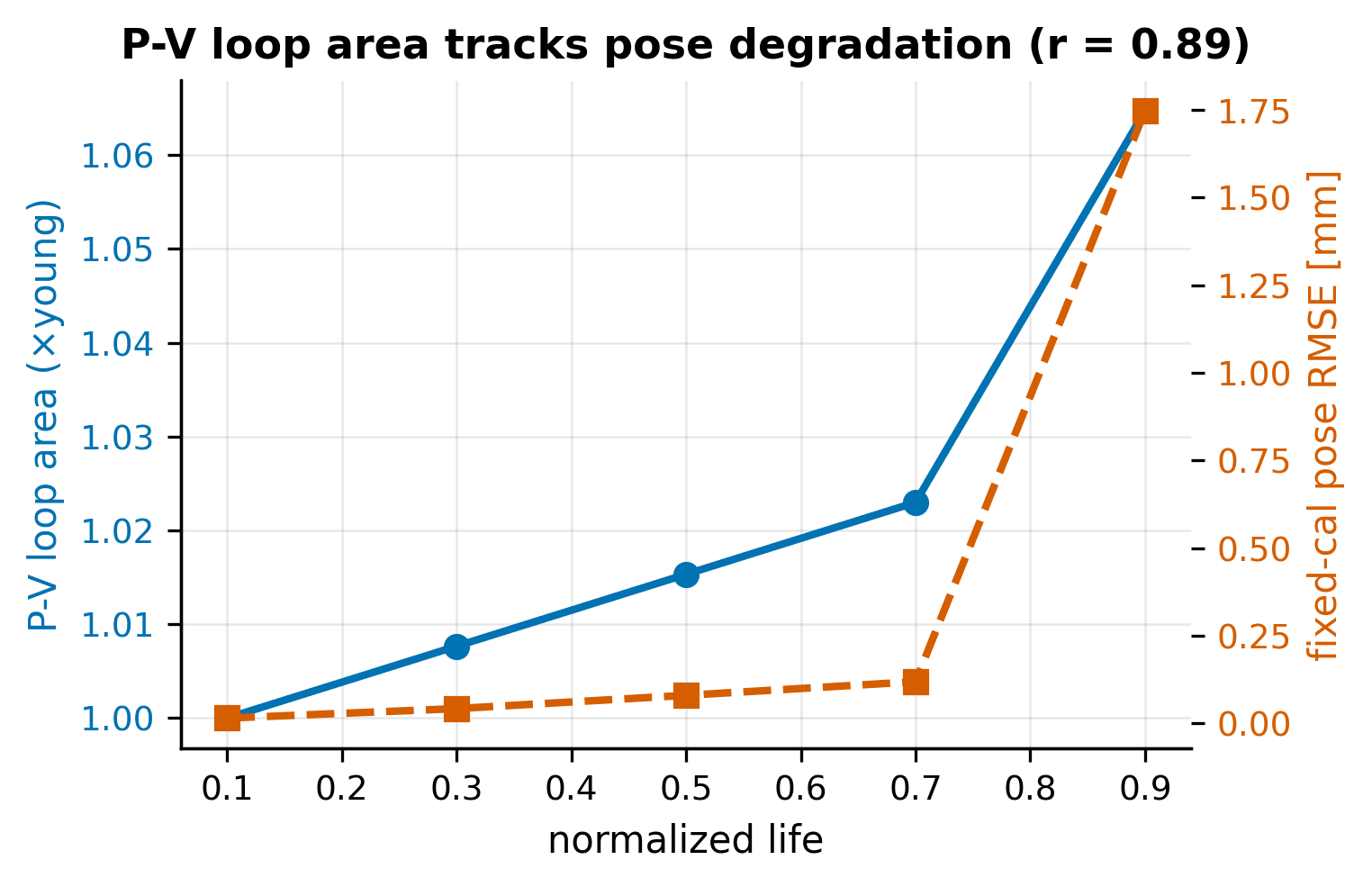
Result. Tracked compliance drift at r = 0.885 (95% actuator-cluster CI 0.853-0.950) by evaluating P-V loop area on six held-out simulated actuators.
This research asks whether a signal already present in pneumatic control—the pressure-volume hysteresis loop—can track fatigue-driven drift and trigger pressure-only proprioception recalibration in a shared-manifold soft gripper. The result is a reproducible simulation pipeline, frozen evaluation, and versioned manuscript.
| Category | Research |
|---|---|
| Timeline | Jun. 2026 - Jul. 2026 |
| Status | Complete |
| Evidence | Actuator-split simulation |
| Role | Research framing, modeling, preregistered evaluation, statistical audit, manuscript, and reproducibility package |
| Tools | Python, NumPy, SciPy, Matplotlib |
| Links | RepositoryFrozen v1.3 |
problem
My contribution. Built the generative model, actuator-identity split, health-indicator and recalibration evaluation, audit checks, figures, and manuscript/release package.
Soft pneumatic grippers age, while pressure-only pose estimators drift with compliance. A useful health indicator must generalize across actuators and must be audited against a simple clock baseline and an explicit temporal-lead definition.
constraints
- Split train and test data by actuator identity rather than by trace.
- Keep every claim simulation-only until matched hardware evidence exists.
- Report negative or threshold-dependent findings without moving the selection rule.
- Make manuscript numbers machine-checkable against committed JSON results.
design evolution
Iterations, issues, and fixes, recorded in the order they happened.
| Revision | Failure mode | Design change | Result |
|---|---|---|---|
| Mechanism model | A plausible shared-manifold effect could be asserted without separating it from global fatigue drift. | Built isolated-versus-shared supply simulations and actuator-level held-out splits. | Cross-talk exists but is second-order at the registered parameters. |
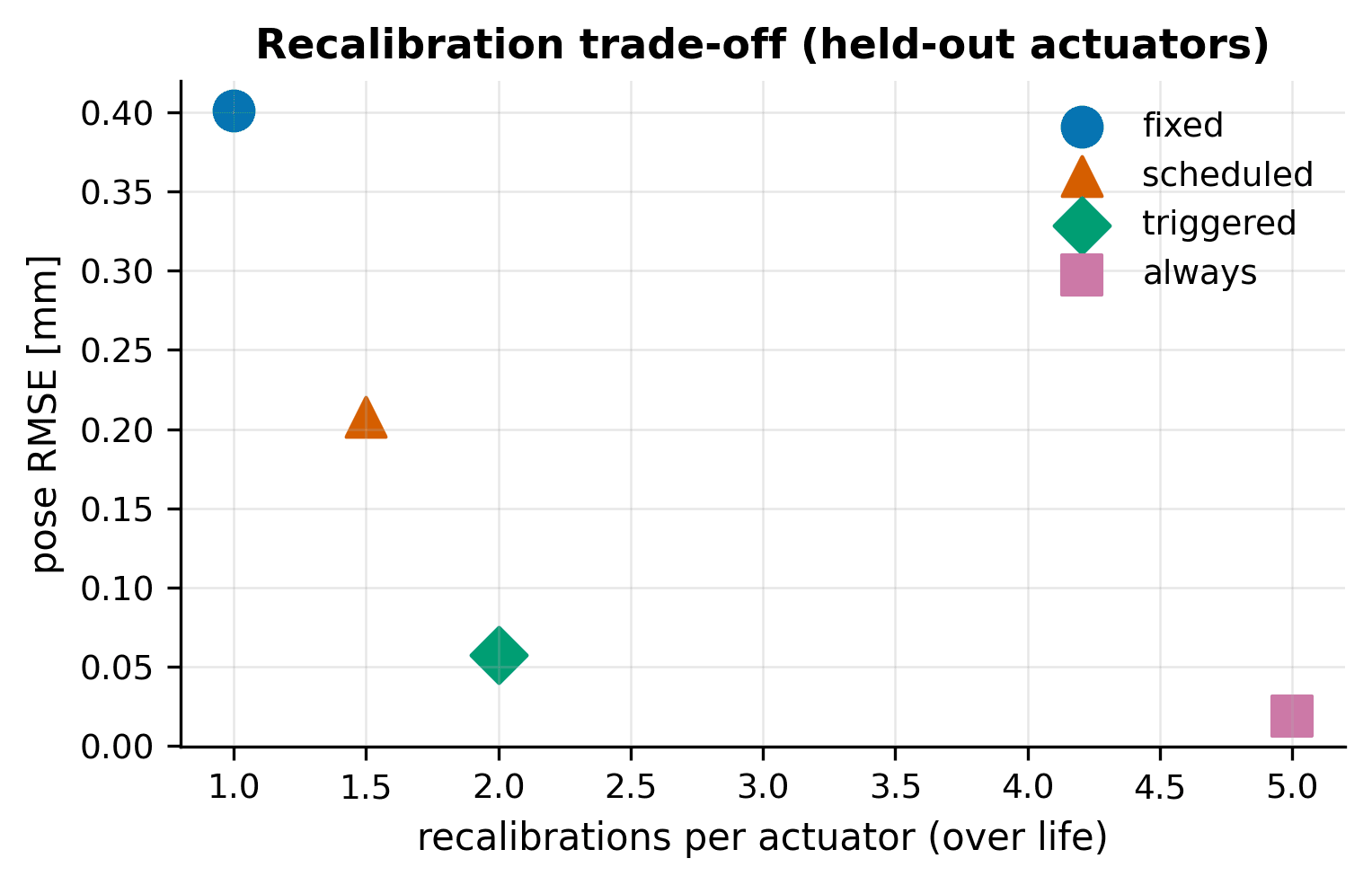
| Lead-time audit | The selected trigger met the error budget but did not provide warning before violation. | Reported a threshold frontier instead of relabeling the deployed threshold. | Median lead is -0.123 normalized life at the deployed threshold; lower thresholds can buy lead at a recalibration cost. |
| Citable package | arXiv endorsement is an external dependency. | Frozen v1.3 bytes, citation metadata, and an August 2 Zenodo fallback. | The application packet no longer depends on an inbox response. |
results
The full suite validates the pneumatic plant, fatigue model, health features, shared-manifold network, actuator-level evaluation, and manuscript-number traceability.
The strongest evidence is not a perfect positive result: the registered trigger saves recalibrations but provides no positive warning time at the deployed threshold.
Scope note. All actuators are generated by one simulation family. No physical fatigue, P-V, or proprioception validation is claimed.
lessons
- A health indicator and a leading indicator are different claims.
- Actuator-identity splits are essential when traces from one specimen are correlated.
- A simple cycle-count baseline can expose whether sensing adds operational value.
gallery