multirotor-recovery-dynamics
A preregistered release-to-recovery study whose placeholder authority fails and whose measured mixer gate will decide the build.
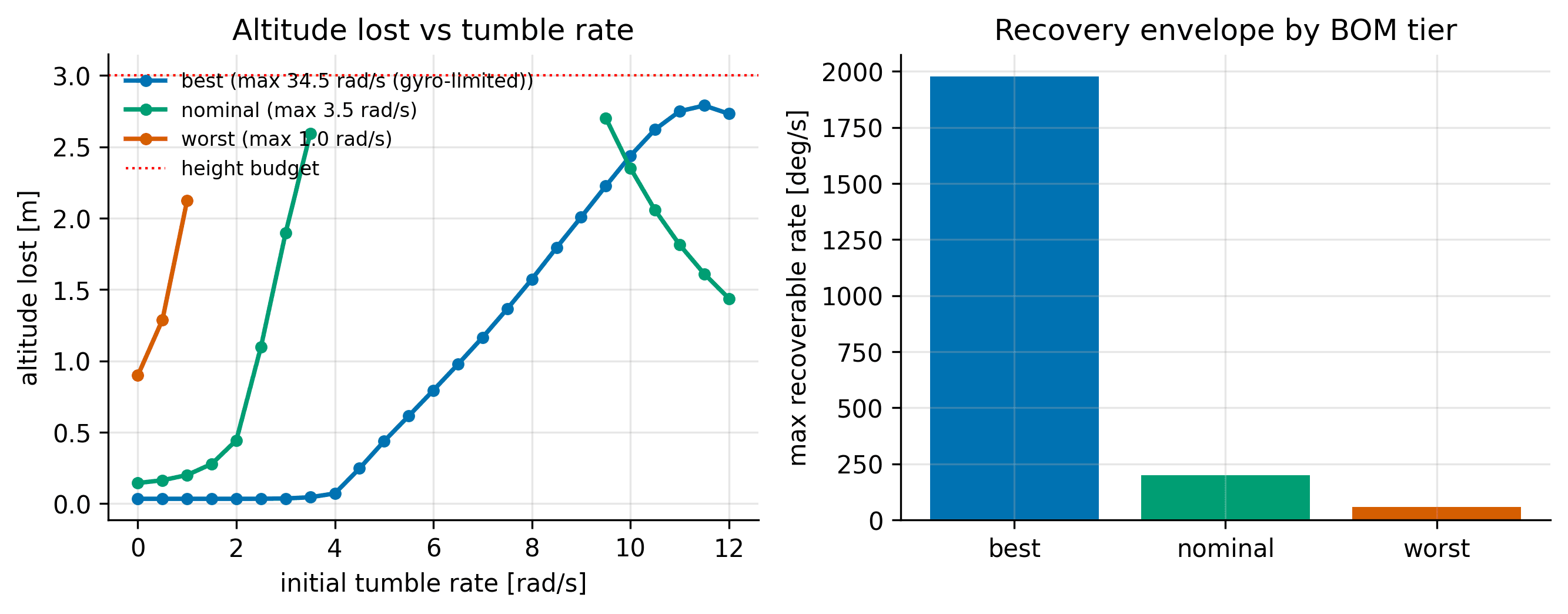
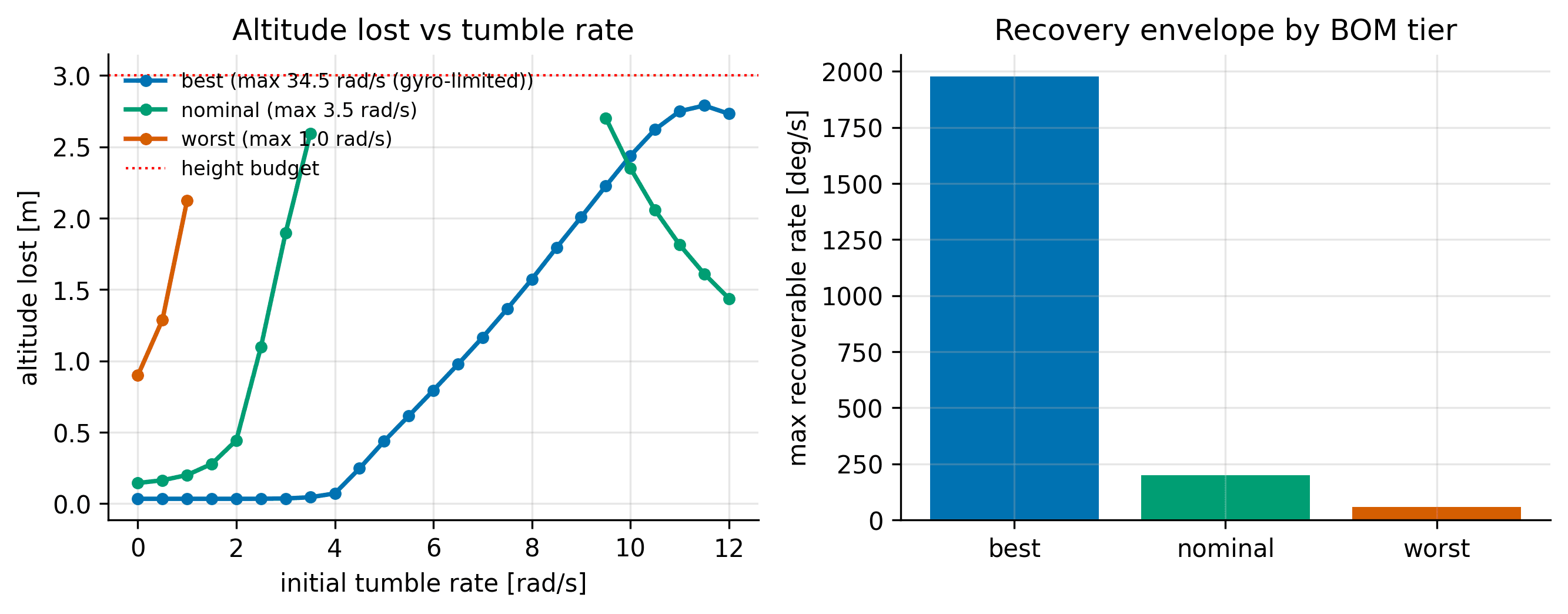
Result. Exposed a 4% recovery rate under placeholder torque, then predicted 300/300 recoveries with a 60 mm mixer model; a six-motor bench test now decides the build.
The guarded micro-UAV concept is developed through staged gates rather than a one-off flight video. The decisive next artifact is measured differential authority at 7.0 V, followed by a fixed 1,000-trial recovery evaluation.
| Category | Robotics Hardware |
|---|---|
| Timeline | Jun. 2026 - Present |
| Status | In Progress |
| Evidence | Monte Carlo prediction; bench test pending |
| Role | Requirements, component selection, dynamics/control simulation, robustness audit, bench protocol, and safety gating |
| Tools | Python, ArduPilot, AM32, CAD |
| Links | RepositoryMeasured Gate |
problem
My contribution. Built the 6-DoF recovery model, imperfection sweep, mixer-authority model, exact confidence-bound gate, component/resource map, and propulsion-bench safety protocol.
A small quad may recover in one nominal simulation while failing across CG error, motor mismatch, latency, noise, and battery sag. The project needs a measurement that decides whether the physical authority premise is viable before more hardware spending.
constraints
- Sub-250 g guarded vehicle and 3.0 m recovery-height budget.
- Measure all six motors at 8.4, 7.6, and 7.0 V.
- Fifth-percentile authority must reach 0.020 N·m throughout 25–75% collective.
- Wave 2 remains blocked until the fixed statistical and safety gates pass.
design evolution
Iterations, issues, and fixes, recorded in the order they happened.
| Revision | Failure mode | Design change | Result |
|---|---|---|---|
| Nominal recovery | A single 60°, 2 rad/s run recovered and could be mistaken for robustness. | Added CG, mass, inertia, motor, latency, noise, and sag dispersions. | The as-toleranced placeholder case recovered only 4% at 2 rad/s. |
| Mixer prediction | The independent 0.004 N·m torque clip ignored real differential mixer headroom. | Modeled collective-dependent four-motor authority and attitude-priority desaturation. | The assumed 60 mm mixer recovered all 300 original trials. |
| Measured decision | “Adequate authority” and “sufficient trials” were soft gates. | Frozen 0.020 N·m and 962/1,000 exact-confidence thresholds plus a LiPo bench checklist. | Wave-2 spending is mechanically tied to measured evidence. |
results
The authority gate uses all six motors, five collective points, and the empirical fifth percentile at 7.0 V.
If authority passes, the fixed 2 rad/s case must achieve at least 962/1,000 recoveries, exact one-sided 95% lower bound ≥0.95, and maximum descent ≤3.0 m.
Scope note. No hardware, propulsion, tethered recovery, or flight result is claimed yet. The 300/300 mixer result uses assumed arm and datasheet thrust.
lessons
- A robustness failure can identify the one measurement that matters most.
- Static thrust times arm validates authority, not dynamic recovery by itself.
- Safety and spending gates belong in the experiment design before hardware arrives.
gallery